Case Study: Interior Designer Website + SEO, Nashik
A Nashik interior designer's portfolio website with SEO started ranking for “interior designer Nashik” within 2 months. What we built and the lessons.
 Uday SatputeFounder & CEO, Clickhold6 min read
- Interior designerNashik
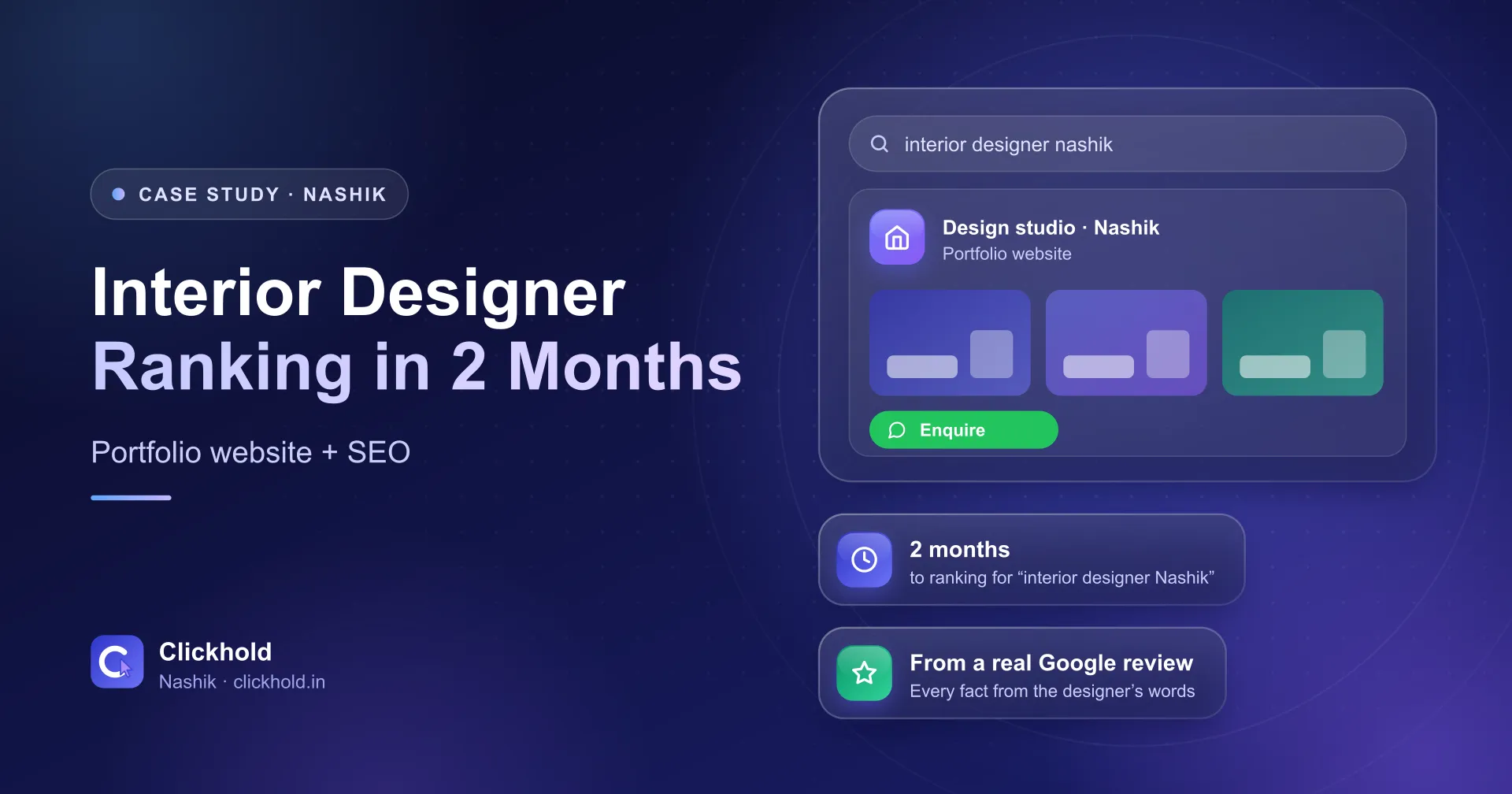
- 2 monthsto ranking for “interior designer Nashik”
- Website + SEOthe two services in the review
- 5★ reviewwritten by the designer
On this page
Quick answer
An interior designer in Nashik asked us for a portfolio website optimised for SEO. In the designer's own Google review, they say they started ranking for “interior designer Nashik” on Google within 2 months, and now gets regular project enquiries through the website.
Case study
Interior designer
Nashik
Ranking within 2 months
Challenge
The designer needed a portfolio website that could be found on Google.
Result
The designer started ranking for “interior designer Nashik” on Google within 2 months and now gets regular project enquiries through the website.
“Within 2 months I started ranking for interior designer Nashik on Google. The website looks clean, loads fast, and I get regular project enquiries through it now.”
Key takeaways
- The work in the review: a portfolio website, optimised for SEO.
- In the designer's words, they started ranking for “interior designer Nashik” on Google within 2 months.
- The review says the site looks clean, loads fast, and brings regular project enquiries.
- For a designer, the website is the portfolio – photos of finished work do the selling.
- Two months was this designer's experience for one search, not a promise; nobody can guarantee rankings.
An interior designer in Nashik asked me for a portfolio website that was optimised for SEO. In their Google review, they wrote that within 2 months they started ranking for “interior designer Nashik” on Google – and that they now get regular project enquiries through the website.
I’m Uday from Clickhold. This case study covers what the designer needed, how we usually build and optimise a site like this, and what other Nashik designers and professionals can learn. Every result here comes from the designer’s own Google review. I haven’t added numbers or details they didn’t share.
What did the interior designer need?
A portfolio website that people could find on Google. Here is the review in full:
“Uday built my portfolio website and optimised it for SEO. Within 2 months I started ranking for interior designer Nashik on Google. The website looks clean, loads fast, and I get regular project enquiries through it now. His knowledge of web development and SEO is excellent. Worth every rupee.”
– Suraj T., interior designer, Nashik (Google review)
Interior design is a high-trust purchase. A family about to spend on a flat’s interiors wants to see finished work, understand the style and feel sure about the person before they call. Much of that checking now starts with a search on a phone.
What did the work involve?
Two things, as the review says: a portfolio website, and SEO on that website. I won’t invent a list of secret tactics. Here is how we usually approach each one for a designer or any portfolio-led business.
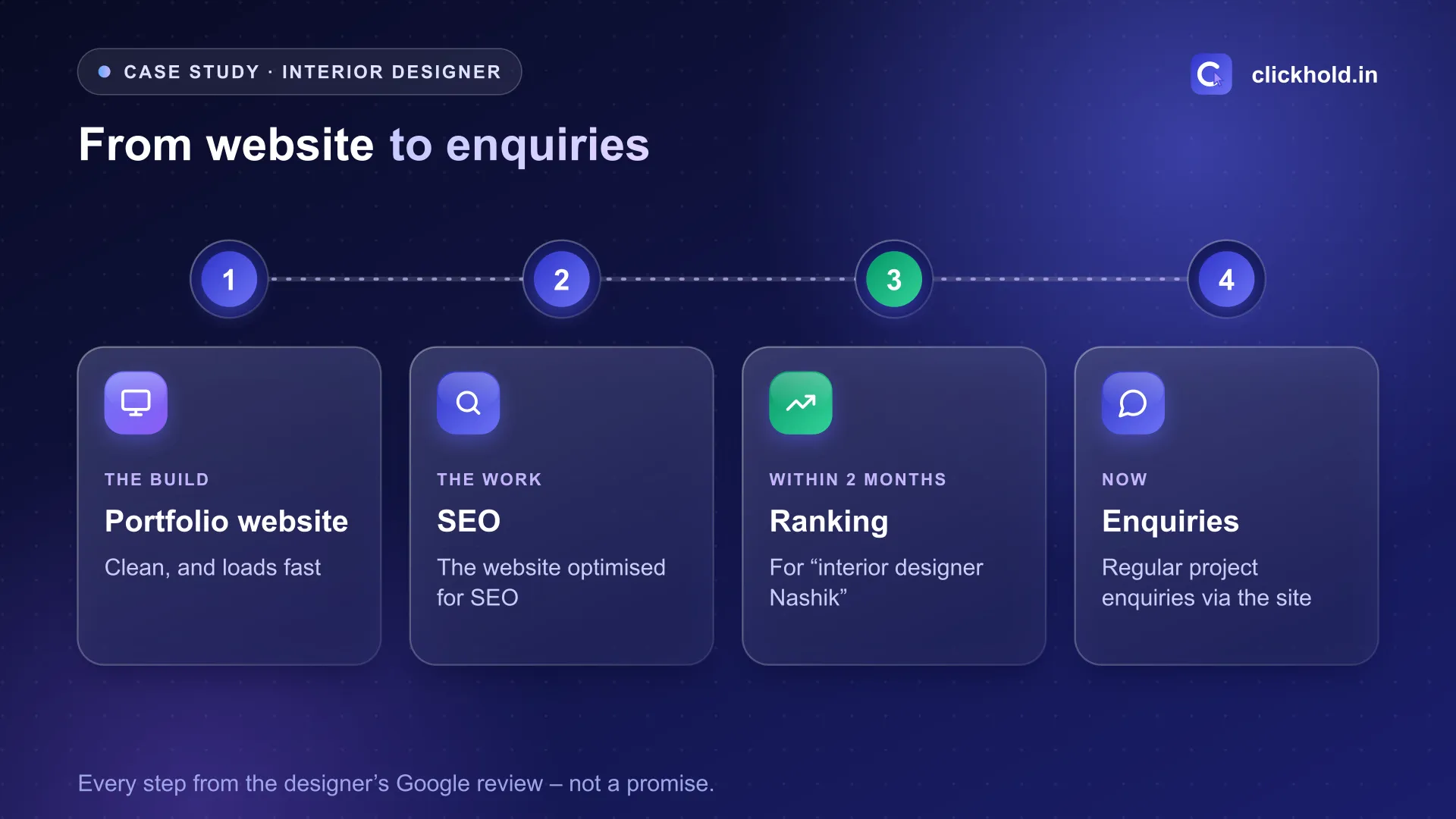
Every step in this timeline comes from the designer's Google review.
How we usually build a portfolio website
- Projects first. The home page leads with finished work – living rooms, kitchens, bedrooms – not a long "about us".
- One page per kind of work. Residential, commercial or modular kitchens each get their own page, so each can answer its own search.
- Light, fast photos. Large photos are resized and compressed so the site stays quick on mobile data.
- Clean layout. Plenty of white space, readable text and a style that matches the designer's own work.
- Easy contact. A WhatsApp button, a call button and a short enquiry form on every page.
The review mentions two of these in the designer’s own words: the site “looks clean” and “loads fast”. Both matter more for designers than for most businesses, because the website itself is a sample of their taste.
How we usually optimise a site like this for SEO
- The right words in the right places. "Interior designer" and "Nashik" in the page title, the main heading and the opening lines – written naturally, not stuffed.
- Descriptive images. Short, descriptive file names and alt text, with each photo placed near the text about it, as Google's image guidelines recommend.
- Technical basics. Mobile-friendly pages, a sitemap, clean links and the site submitted to Google Search Console.
- Local details. The Nashik address or service area, phone number and the areas served, the same everywhere.
- Content that answers questions. What the process looks like, how a project starts and which areas are covered.
I can’t tell you which single step made the difference – the review doesn’t say, and with the website and SEO built together, nobody could honestly separate them.
What were the results?
Exactly as the designer wrote them:
- Ranking for “interior designer Nashik” on Google within 2 months.
- Regular project enquiries through the website.
- The designer describes the site as clean and fast, and the service as “worth every rupee”.
That’s all I’ll claim. The review doesn’t say how many enquiries, which position the site reached or what projects came in, so I won’t guess.
A note on timing
Two months was this designer's experience for one search. Google itself says no one can guarantee a #1 ranking. Your timing depends on competition, how good your content is and the state of your website.
Why do a website and SEO suit interior designers?
Because people judge designers by their work, and they look for that work on Google. This part is my opinion, not something from the review.
| Instagram only | Website + SEO | |
|---|---|---|
| Found by a Google search | Rarely for “interior designer Nashik” | Can rank for searches about your service and city |
| Your portfolio | Mixed into a feed | Organised by project and type of work |
| Who owns it | The platform | You – domain and site in your name |
| How people contact you | DMs | Call, WhatsApp and an enquiry form |
Instagram is still useful – it’s where many people discover design ideas. But a website does a different job: it answers the search of someone who is ready to hire, and it keeps the full portfolio in one place.
What does the designer need to do?
A website and SEO bring enquiries. Winning projects is still the designer’s job, and a few habits help a lot:
- Add new projects regularly. Fresh, real photos of finished work give people a reason to trust you – and give Google new content.
- Reply to enquiries quickly. Homeowners usually contact two or three designers. The quick, clear reply often gets the site visit.
- Share a rough budget range when people ask. It saves time for both sides.
- Ask happy clients for a Google review after handover – never buy reviews or offer discounts for them.
- Keep details the same on the website, Google and social media: name, phone, area.
What can other Nashik professionals learn from this?
This applies well beyond interiors: architects, photographers, wedding planners, landscape designers and furniture makers all sell through a portfolio.
- Search your own service + “Nashik” in a private window. Do you show up at all?
- Lead with your best work. Ten strong projects beat fifty average ones.
- Give each service its own page, so each can match its own search.
- Keep the site fast. Big, unoptimised photos are the most common reason portfolio sites are slow.
- Make contact one tap away on every page – WhatsApp, call and a form.
- Judge SEO over months, not days. Track enquiries, not just rankings.
If you want to know what monthly SEO involves and costs, read my guide to SEO cost per month in Nashik. For website prices, see website cost in Nashik. For a shop that used Google Ads and Maps instead, see the furniture shop case study. Another client’s story, with SEO on every page, is in the portfolio website case study.
Would this work for your business?
If customers judge you by your work before they call, a portfolio website with SEO is usually where I’d start. Website development starts from ₹5,999 for 6–10 pages, and SEO services start from ₹5,599 per month with no long lock-in.
Not sure where your site stands today? Send me a WhatsApp message with your website link and the search you want to be found for. I’ll tell you honestly what I’d fix first.
Want us to look at your business?
Send a WhatsApp message – you'll get honest advice and a clear, written price.
Frequently asked questions
How long did the interior designer take to rank on Google?
About two months. In the designer's Google review, they say that within 2 months they started ranking for “interior designer Nashik”. That was one business and one search; timing for another site depends on competition, content and the site itself.
What work was done for the interior designer?
The review names two things: a portfolio website, and SEO optimisation of that website. This post explains how we usually approach both for a designer – it doesn't claim any extra work the review doesn't mention.
Does an interior designer need a website if they have Instagram?
Instagram is good for showing work, but a website can rank on Google for searches like “interior designer Nashik”, holds your full portfolio in one place, and belongs to you. Many designers use both, with Instagram linking to the site.
How much would a website and SEO cost with Clickhold?
A business website starts from ₹5,999 for 6–10 pages, and monthly SEO starts from ₹5,599 per month with no long lock-in. Domain and hosting are at actual cost, in your name. You get a fixed quote before any work starts.
Why isn't the designer's studio named in this case study?
Because we only publish what the client shared publicly, and the review doesn't name the studio. We never show a client's business name without permission.