Lead Generation for Small Business: A Simple 2026 Guide
Lead generation for small business, step by step: get found on Google and Instagram, capture the enquiry, reply in minutes and track the cost per customer.
 Uday SatputeFounder & CEO, Clickhold6 min read
- 4 partsget found, capture, reply, track
- Minuteshow fast a new lead should hear from you
- Cost per customerthe number that matters – not lead count
On this page
Quick answer
Lead generation for a small business is a simple system with four parts: get found (Google Business Profile, search ads, Instagram), capture the enquiry on one page or a WhatsApp chat, reply within minutes, and track where every lead came from and what each customer cost.
Key takeaways
- Fix the free channel first: a complete Google Business Profile brings calls before you spend on ads.
- Send every ad to one page or one WhatsApp chat built for one action – not your home page.
- Reply to new enquiries within minutes during work hours; set an away message for the rest.
- Write down the source and status of every lead, and judge each channel by cost per customer won.
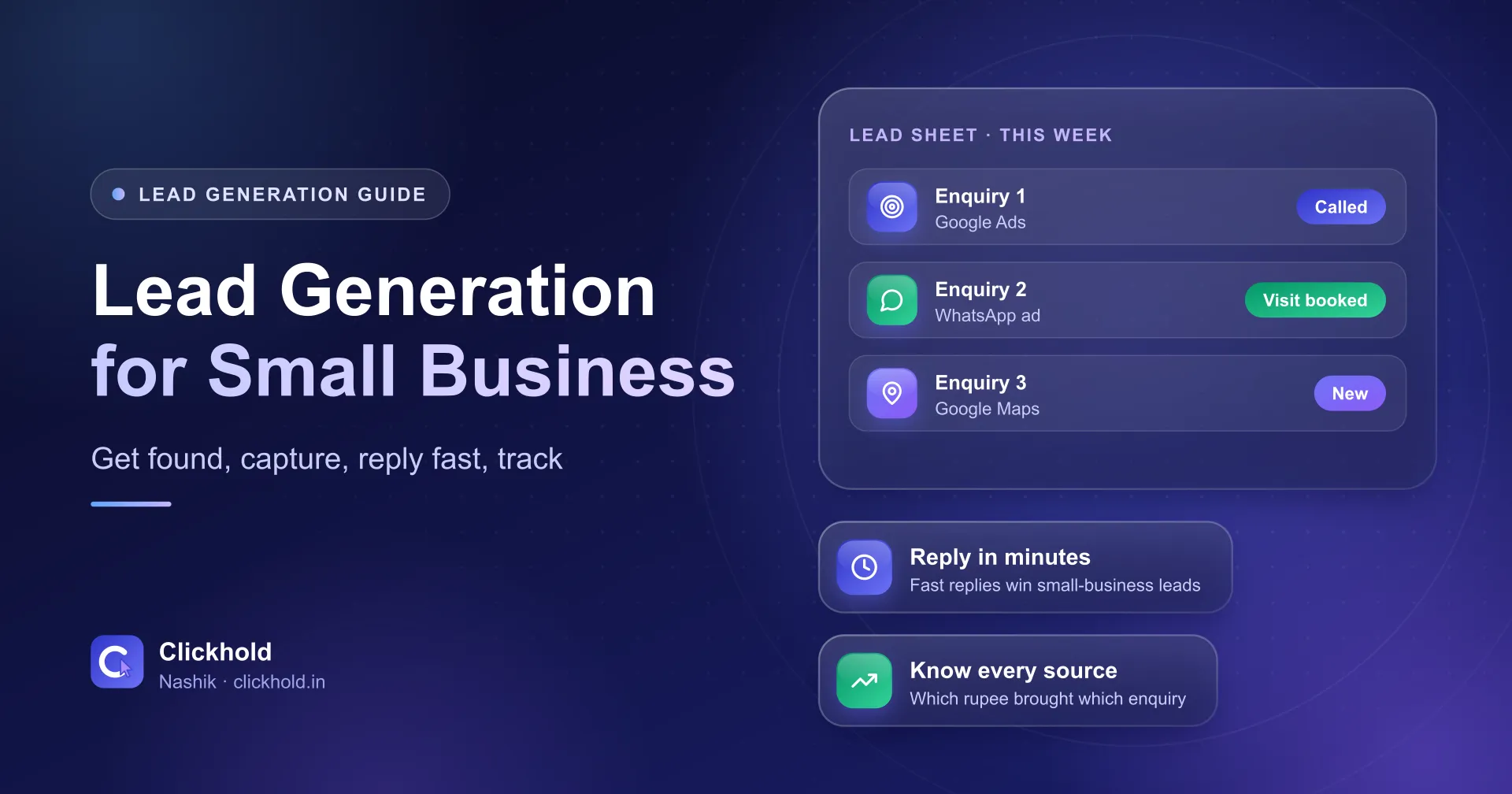
Lead generation for a small business is not one ad or one tool. It is a simple system with four parts: people find you, you capture their enquiry, you reply fast, and you track which source brought which customer. Get those four right and even a small budget works harder.
I’m Uday from Clickhold in Nashik. Most shop owners, clinics and service businesses who call me say the same thing: “We tried ads, they didn’t work.” When I look closer, the ads were often fine – the enquiries were lost at the reply or never counted. This guide is the order I fix things in.
What is lead generation for a small business?
A lead is a person who has asked about what you sell – by call, WhatsApp, form or a walk-in. Lead generation is everything that makes that happen, and everything after it until they buy.
For a big company it means sales teams and software. For a small business it is much simpler:
- One or two places where people find you
- One clear way to contact you
- Someone who replies quickly
- A notebook or sheet that records each lead
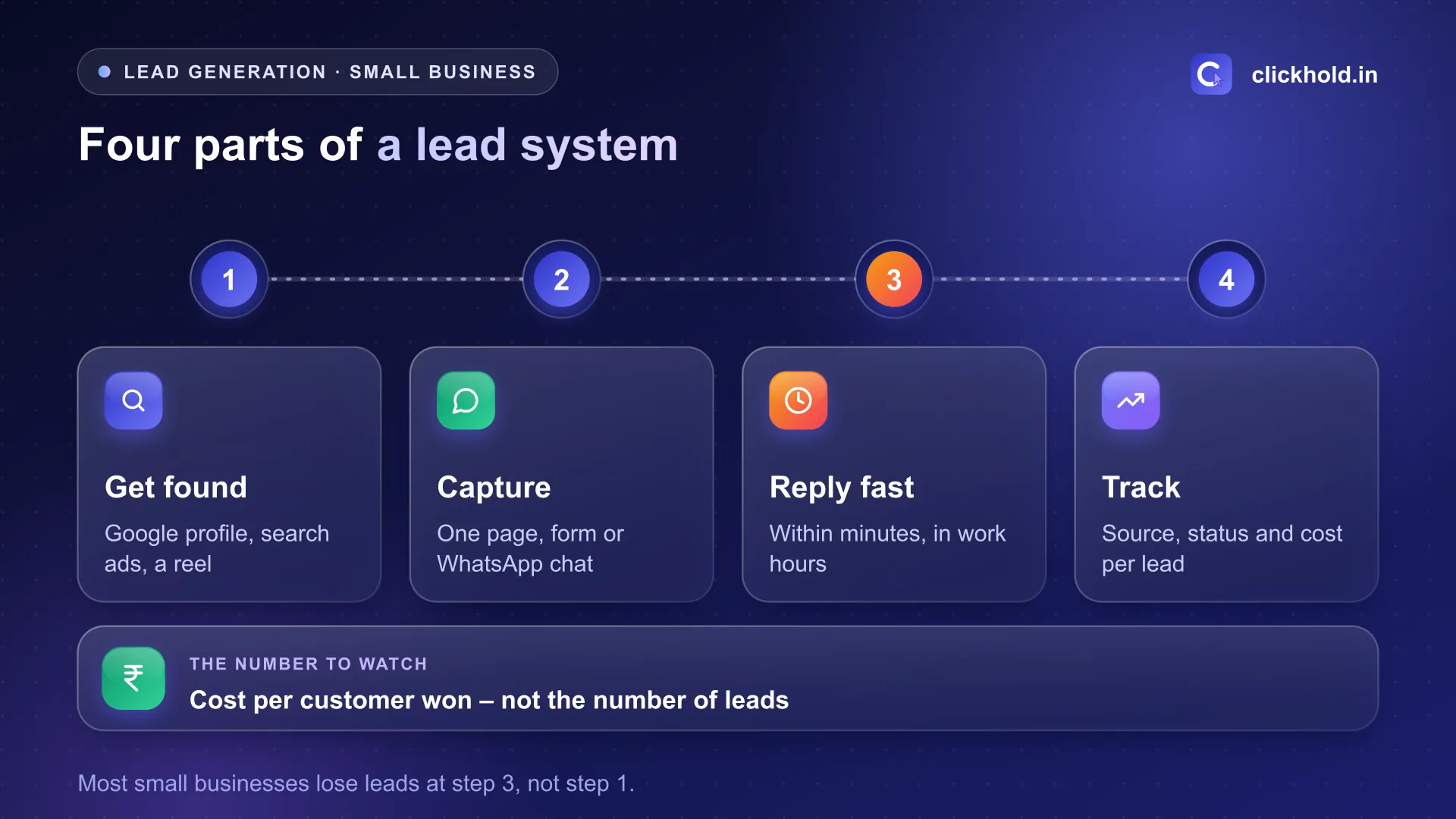
The four parts of a small-business lead system. Most leads are lost at step 3.
Where do small-business leads come from?
For most local businesses, three sources do most of the work. Start with the free one and add paid ones when the basics work.
| Source | Cost | Who it reaches | Best for |
|---|---|---|---|
| Google Business Profile | Free to run | People searching nearby on Maps and Search | Shops, clinics, repairs, restaurants |
| Google Search ads | Ad budget + management | People already searching for your service | Urgent or high-value services |
| Instagram & Facebook ads | Ad budget + management | People not searching yet, in your area | Products people buy when they see them |
Google Business Profile – start here
If your Maps listing is incomplete, fix it before you pay for any ad. A correct category, exact pin, opening hours, photos and replies to reviews bring calls at no running cost. My step-by-step guide shows how to create a Google Business Profile, and if yours isn’t appearing, read why a business doesn’t show on Google Maps.
Google Search ads – for people already looking
Search ads show when someone types what you sell, like “AC repair near me”. These leads are usually warm because the person has a need right now. Google also offers lead form assets on Search campaigns, so people can send their details without leaving the ad – but Google stores those leads for only 60 days, so download them often.
Instagram and Facebook ads – for people not searching yet
Meta ads put your offer in front of people near you who weren’t looking. They work well for food, fashion, beauty, classes and festival offers. Leads are cheaper but colder, so they need faster follow-up. My click-to-WhatsApp ads checklist covers the most useful format for small shops.
Where should the enquiry land?
On one page or one WhatsApp chat built for one action. Not your home page, not your Instagram profile.
A good landing spot has:
- A headline that repeats what the ad promised
- The price, or “starting from”, if you can share it
- Real photos and one or two genuine reviews
- One clear button: Call, WhatsApp or Book
- A short form – name, phone and one question that shows how serious they are
Keep it light and fast on a phone. Most of your visitors will open it on mobile data. If you don’t have a page like this, a simple business website with call and WhatsApp buttons is enough to start.
How fast should you reply to a lead?
Within minutes during work hours. This is where small businesses lose the most money. In my experience, someone who sends an enquiry often contacts two or three businesses at once. The first one to reply properly usually gets the conversation.
What I set up with every client:
- Leads reach a phone straight away – not only an email inbox nobody checks till evening.
- One person owns replies during work hours, with a backup on Sundays and holidays.
- Ready answers in WhatsApp Business. The app lets you save quick replies for common questions like price and location.
- An away message for night-time chats, so people know when you’ll answer. WhatsApp Business can send away messages outside your business hours.
If you can’t reply fast, run fewer ads. Ten leads answered in ten minutes beat fifty answered tomorrow.
How do you track leads without software?
A simple sheet with five columns is enough for most small businesses. Fill it in every day:
| Date | Name & phone | Source | Status | Value |
|---|---|---|---|---|
| 17 Oct | Customer A | Google Maps call | Visited | ₹ – |
| 17 Oct | Customer B | WhatsApp ad | Quote sent | ₹ – |
Use the same status words every time: new, replied, quote sent, visited, won, lost. Ask every caller, “How did you find us?” and write it down.
Once a month, add up what you spent on each source and how many customers it brought. Spend ÷ customers won = cost per customer. Compare sources on that number, not on the number of leads. In my experience the cheapest leads are often not the cheapest customers.
What mistakes waste a small lead budget?
The same five, again and again:
- Ads before basics. Paying for clicks while the Maps listing has the wrong phone number.
- Sending everyone to the home page. People can’t find the button and leave.
- Slow replies. The lead was real; the answer came a day late.
- No tracking. You can’t tell which rupee worked, so you cut the wrong thing.
- Buying lists. People who never asked about you, and calls that hurt your name.
Avoid these and your first month of ads tells you something useful, even if it’s small.
Should you hire someone for lead generation?
Do it yourself if you have time and one channel; get help when you run two or more. A profile and a WhatsApp routine are easy to run yourself. Search and Meta ads, landing pages and tracking take regular work each week.
If you hire an agency, ask three things: Will the ad accounts be in my name? Will I see every lead and its source? What happens if leads are poor quality? A good answer to all three matters more than any promise.
For Nashik businesses, my lead generation service sets up all four parts – ads, a page or WhatsApp flow, tracking and a follow-up routine – as a custom quote. If you need only one piece, see Google Ads management (from ₹5,400/month), Facebook & Instagram ads (from ₹4,499/month) or a Google Business Profile setup (from ₹2,799 one-time). Builders and brokers can also read my real estate lead generation guide, and MIDC units my guide to B2B lead generation for Nashik manufacturers.
I can’t promise you a number of leads – nobody honestly can. But I can make sure you know exactly what each rupee brought.
Want us to look at your business?
Send a WhatsApp message – you'll get honest advice and a clear, written price.
Frequently asked questions
What is lead generation for a small business?
It is getting enquiries – calls, WhatsApp chats or form fills – from people who may buy, and following up until they do. Ads are only one part; the page, the reply and the tracking matter just as much.
What is the cheapest way to get leads for a small business?
A complete, accurate Google Business Profile costs nothing to run and brings calls and direction requests from people nearby. Add genuine reviews and replies, then consider ads once the basics work.
Should I buy lead lists?
I don't recommend it, and Clickhold doesn't sell data. Bought lists are people who never asked about you. Leads from your own profile and ads are fresher and belong to you.
How many leads will I get from ads?
Nobody can honestly promise a number. It depends on your offer, price, area, competition and budget. What you can insist on is tracking, so you see what each lead cost and where it came from.
How much do lead generation services cost in Nashik?
At Clickhold, lead generation is a custom quote – WhatsApp us. Your ad budget is paid directly to Google or Meta. Single services start from ₹4,499 per month for Meta Ads and from ₹5,400 per month for Google Ads.